Parameters
intermediate conceptsGlobal Snow & Rain 3 · Core Concepts
All settings live in the Global Snow component on the camera. The inspector starts with the Weather block, followed by seven foldouts. A dot after a label (for example Snow •) means that effect is on. Move the mouse over any label in the inspector to read a short description.
Weather
The top block holds one slider per effect, the Sun, the Profile and the quality Presets. Setting a slider to 0 turns that effect off.
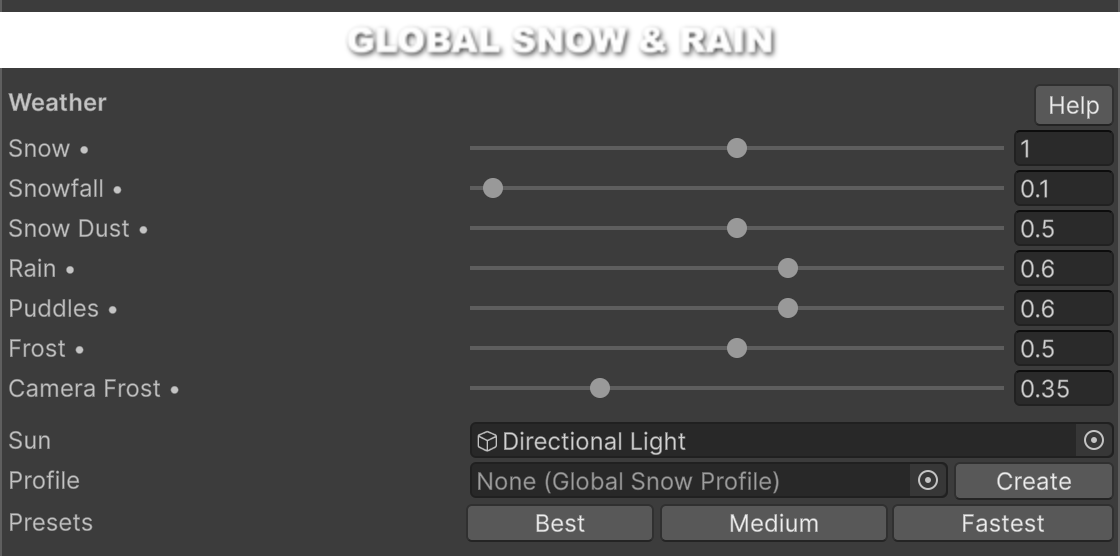
| Parameter | Description |
|---|---|
| Snow | Global snow amount. From 0 to 1 the snow fades in, from 1 to 2 it grows thicker. Default 1. |
| Snowfall | Density of the falling snowflakes. Range 0 to 4. 0 turns snowfall off. Default 0.1. |
| Snow Dust | Number of animated dust puffs near the ground, carried by the wind. It is not a transparency value. Range 0 to 1. 0 hides the dust. Default 0. Needs the Depth Texture option in the URP asset. |
| Frost | Hoarfrost ice on the ground and walls. Range 0 to 1. 0 turns it off. Default 0. |
| Camera Frost | Intensity of the frost on the camera view. It grows in from the edges of the screen as it rises. Range 0 to 1.5. 0 turns it off. Default 0.35. |
| Rain | How much it is raining: falling rain plus wet surfaces exposed to the sky. Range 0 to 1. Default 0. |
| Puddles | How much standing water the scene has. It works on its own, also without rain. Range 0 to 1. Default 0. |
| Camera Rain | Drops on the camera lens while it rains, scaled by Rain. Range 0 to 1. 0 turns it off. Default 0. |
| Sun | Directional light used for the snow lighting. If empty, Global Snow uses the first directional light it finds in the scene. |
| Profile | Optional Global Snow Profile asset with snow and rain settings to reuse. Assigning a profile applies it. Create makes a new profile from the current settings. |
| Profile > Revert | Loads the settings from the profile. |
| Profile > Apply | Saves the current settings into the profile. |
| Presets > Best | Relief Mapping, Coverage Quality 3, Running Drops at full resolution and Deep Marks on. |
| Presets > Medium | Normal Mapping, Coverage Quality 2, Running Drops at half resolution and Deep Marks on. |
| Presets > Fastest | Flat Shading, the lowest Coverage Quality the Coverage Extension allows, and Running Drops and Deep Marks off. |
Coverage
Controls where snow can appear: layers, excluded objects, altitude, the top-down coverage capture, grass and the coverage mask.
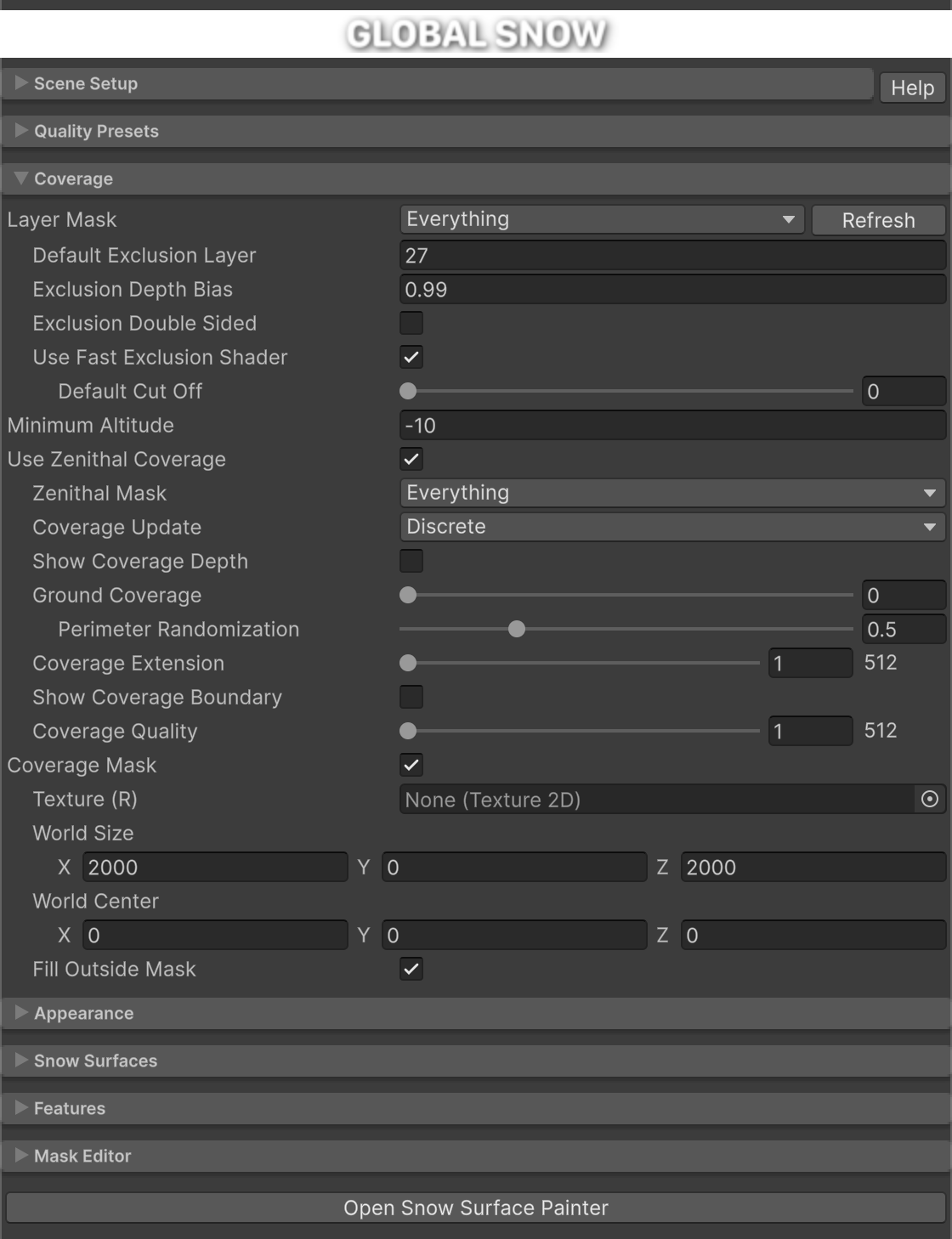
| Parameter | Description |
|---|---|
| Layer Mask | Layers that can receive snow. Objects on other layers get no snow. Objects on the Default layer are always included, so use the Global Snow Ignore Coverage component to exclude them. Refresh applies the change. Default: all layers. |
| Layer Mask > Default Exclusion Layer | Layer used internally to keep snow off excluded objects. Pick a layer that no object uses. Default 27. |
| Layer Mask > Exclusion Depth Bias | Depth comparison bias for excluded objects. Change it if snow shows at the borders of excluded objects. Default 0.99. |
| Layer Mask > Exclusion Double Sided | Enable it when you exclude double sided objects. Default off. |
| Layer Mask > Use Fast Exclusion Shader | Uses a fast mask shader to exclude objects. Disable it for objects with vertex animation, like trees or vegetation, so Global Snow uses their own material instead. Default on. |
| Use Fast Exclusion Shader > Default Cut Off | Alpha cut off used when excluding objects. The Global Snow Ignore Coverage component can set its own value per object. Range 0 to 1. Default 0. |
| Minimum Altitude | Snow level. There is no snow below this world height. Default -10. |
| Minimum Altitude > Altitude Range | Height in meters above Minimum Altitude where the snow appears in growing patches. Above that height only Scatter applies. 0 makes the snow start right at Minimum Altitude. Its effect fades out as Snow goes from 1.5 to 2. Default 0. |
| Use Zenithal Coverage | Computes the snow coverage automatically with a top-down capture, so surfaces under roofs, bridges or trees get no snow. Snowfall, rain and puddles also use it to stay out from under cover. Default on. |
| Use Zenithal Coverage > Zenithal Mask | Layers that take part in the top-down capture. Objects on top keep the snow off what is below them. Exclude particle systems and small moving objects. Default: all layers. |
| Use Zenithal Coverage > Coverage Update | When the coverage is captured again. Every Frame, Discrete (after the camera moves 50 meters), Manual (call UpdateSnowCoverage() from a script) or Disabled. Default Discrete. |
| Use Zenithal Coverage > Cull Mode | Normal respects the culling of each material. Both Faces also captures the back faces of single sided roofs, so they block snow, rain and puddles underneath. Default Normal. |
| Use Zenithal Coverage > Ground Coverage | Lets snow get under opaque objects. The snow fills in under the lowest covers, comes in patches under higher ones, and the highest stay clear. Range 0 to 0.5. Default 0. |
| Use Zenithal Coverage > Coverage Scatter | Width in meters of the snow scattered in patches outward from what covers the ground (trees, eaves, bridges). The snow layer thins toward the cover and snow never gets under it. It uses the Scale and Edge Softness of Scatter, and grows with the covers that Ground Coverage leaves clear. 0 gives a clean edge. Range 0 to 8. Default 0. |
| Add Snow To Grass | Replaces the URP terrain grass shader with a shader that supports snow. Stop and start the scene to see the change. Default off. |
| Grass Coverage > Altitude Offset | Height offset added to Minimum Altitude for terrain grass only. Default 0. |
| Grass Coverage > Coverage | Amount of snow on grass. Range 0 to 1. Default 0.75. |
| Coverage Extension | Size of the area around the camera covered by the top-down capture: 1 = 512 m, 2 = 1024 m, 3 = 2048 m, 4 = 4096 m. A larger area gives less detail. Default 1. |
| Coverage Quality | Resolution of the coverage texture: 1 = 512, 2 = 1024, 3 = 2048, 4 = 4096 pixels. With a Coverage Extension above 1, the quality is at least 2. Default 1. |
| Coverage Mask | Uses a texture to choose where snow appears. The mask also removes rain wetness and puddles, and limits the snow dust. Default off. |
| Coverage Mask > Texture (R) | Mask texture. Black means no snow, white means full snow. If the inspector warns about the import settings, click Fix Texture Import Settings. |
| Coverage Mask > World Size | World size covered by the mask texture. Usually it matches the terrain size. Default 2000 x 2000. |
| Coverage Mask > World Center | World position of the mask center. Use it to place the mask over a given area. Default 0, 0, 0. |
| Coverage Mask > Fill Outside Mask | Fills the area outside the mask with snow. Default on. |
Global Snow Ignore Coverage component give extra control per area and per object.
Mask Editor
The Mask Editor paints the coverage mask directly in the Scene View. Click and drag over objects that have colliders. It shows when a single Global Snow component is selected.
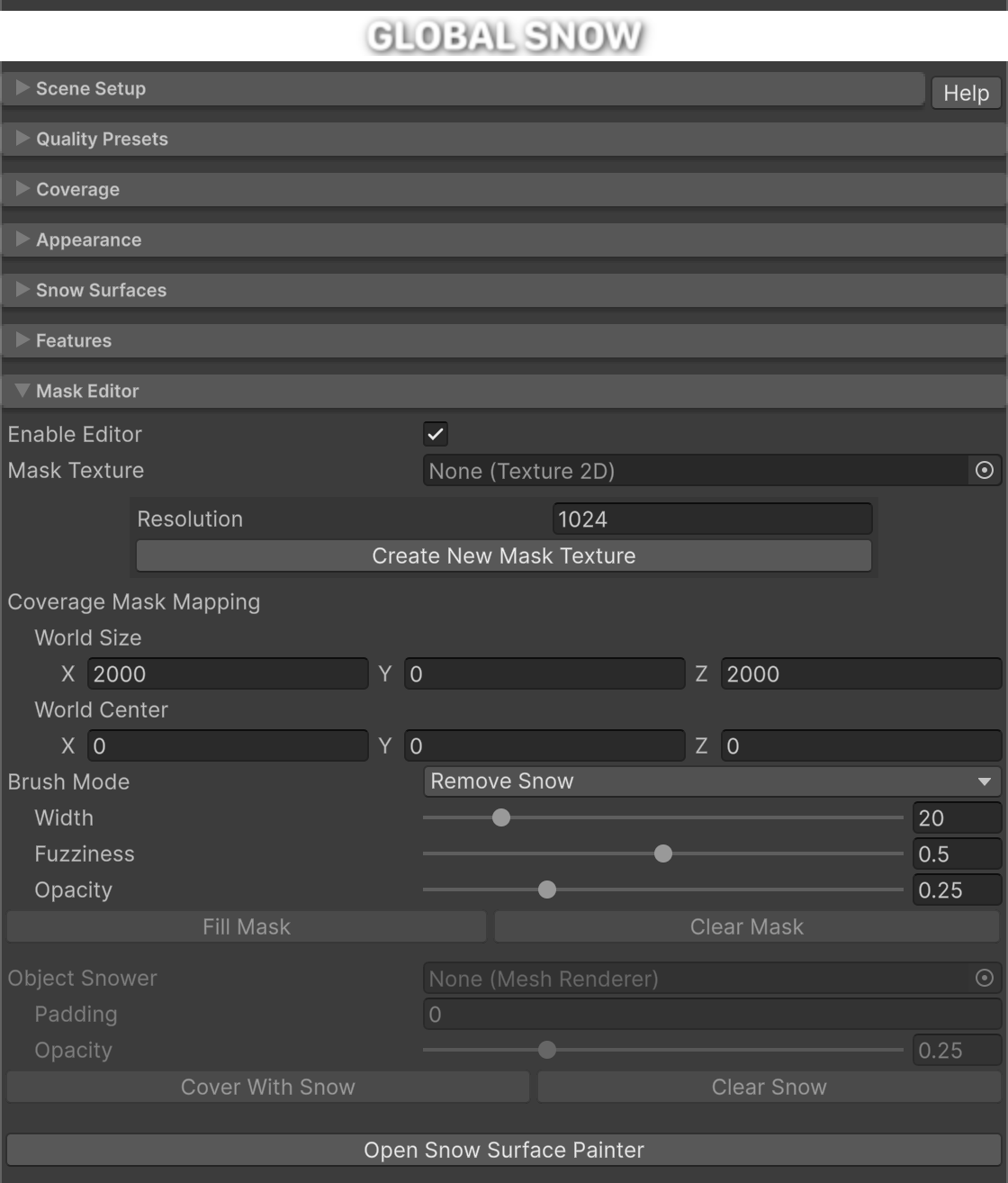
| Parameter | Description |
|---|---|
| Enable Mask Editor | Turns on the brush in the Scene View. If Coverage Mask is off, a button offers to enable it. |
| Texture Size / Texture Path | Size and asset path of the current mask texture. |
| Resolution | Size in pixels of a new mask texture, from 256 to 8192. Higher values give more detail but paint slower. Default 1024. |
| Create New Mask Texture | Creates a mask texture asset filled with snow (Assets/SnowMaskTexture.asset) and assigns it. |
| Brush Mode | Add Snow or Remove Snow. Default Remove Snow. |
| Brush Mode > Width | Brush radius in world units. Range 1 to 128. Default 20. |
| Brush Mode > Fuzziness | Solid or spray brush. Range 0 to 1. Default 0.5. |
| Brush Mode > Opacity | Opacity of each stroke. Range 0 to 1. Default 0.25. |
| Fill Mask / Clear Mask | Fills the whole mask with snow, or removes all the snow. |
| Object Snower | A Mesh Renderer in the scene. The buttons below add or remove snow over the area it covers. |
| Object Snower > Padding | Extra border around the area of the object. |
| Object Snower > Opacity | Opacity of the fill. Range 0 to 1. Default 0.25. |
| Object Snower > Cover With Snow / Clear Snow | Adds or removes snow over the area of the object. |
Snow Appearance
The look of the snow: shading detail, the snow layer, slopes, bare patches, color and lighting.
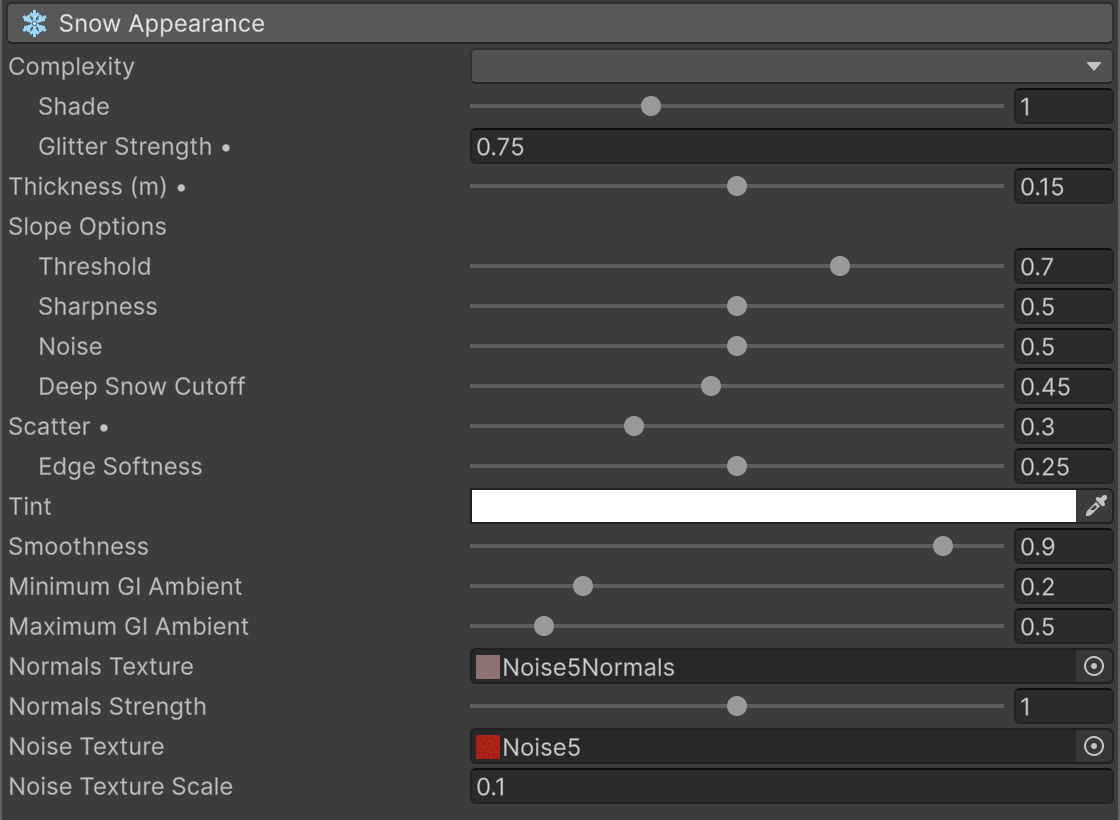
| Parameter | Description |
|---|---|
| Complexity | Shading of the snow. Flat Shading is the fastest, Normal Mapping adds normal detail, Relief Mapping adds relief with depth. Default Relief Mapping. |
| Complexity > Relief Amount | Relief intensity. Only with Relief Mapping. Range 0.05 to 0.3. Default 0.3. |
| Complexity > Shade | How much the snow relief, the marks and the layer edges are shaded toward the sun, also in shadow. 0 uses only the scene lighting, above 1 is more dramatic. Not with Flat Shading. Range 0 to 3. Default 1. |
| Complexity > Glitter Strength | Sparkle on the snow. 0 turns it off. Not with Flat Shading. Default 0.75. |
| Thickness (m) | Thickness of the snow as a layer over the ground. It buries what rests in it, and Deep Marks dig into it as deep as it goes. 0 means no layer: the snow is drawn on the surfaces and only Footprints and Collision Marks mark it. Range 0 to 0.3. Default 0.15. |
| Slope Options > Threshold | Steepest slope where snow can stay. Range 0 to 1. Default 0.7. |
| Slope Options > Sharpness | Sharpness of the snow edge on slopes. Range 0 to 1. Default 0.5. |
| Slope Options > Noise | Random variation in the area between low and high slopes. Range 0 to 1. Default 0.5. |
| Slope Options > Deep Snow Cutoff | With Snow above 1, the steepest slope the extra snow fills. It compares the surface normal Y, so lower values reach steeper slopes. Range 0 to 1. Default 0.45. |
| Scatter | Share of the ground left bare in irregular patches. 0 leaves no bare patches, 1 leaves almost no snow. Its effect fades out as Snow goes from 1.5 to 2. Range 0 to 1. Default 0. |
| Scatter > Scale | Size in meters of the patches left by Scatter, Coverage Scatter and Ground Coverage. Shown when any of them is above 0. Range 1 to 32. Default 16. |
| Scatter > Edge Softness | Width of the slope where the snow layer thins down to the bare patches of Scatter, Coverage Scatter and Ground Coverage. 0.1 gives steep edges, 1 gives very gentle slopes and a much thinner layer on average. Shown when any of them is above 0 and Thickness is above 0. Range 0.1 to 1. Default 0.25. |
| Tint | Snow color tint. Default white. |
| Smoothness | How sharp the snow reflections are. Range 0 to 1. Default 0.9. |
| Minimum GI Ambient | Lowest ambient light on the snow. The snow takes the scene ambient light (Environment Lighting) and never goes below this value. Range 0 to 1. Default 0.2. |
| Maximum GI Ambient | Highest ambient light on the snow. Lower it to darken the snow when the scene ambient light is very bright. Range 0 to 4. Default 0.5. |
| Normals Texture | Normal map for the snow detail. Not with Flat Shading. If empty, the bundled texture is used. |
| Normals Strength | Strength of the snow normal map. Range 0 to 2. Default 1. |
| Noise Texture | Noise texture that adds variation to the snow. If empty, the bundled texture is used. |
| Noise Texture Scale | Tiling of the noise texture. Lower values give larger, smoother patterns. Default 0.1. |
Footprints & Marks
Everything that marks the snow. Deep Marks dig into the snow layer. Surface Marks (Footprints and Collision Marks) are drawn on the snow. The Common options apply to all of them. Marks also ripple the puddles when Contact Ripples is on (see Rain & Water).
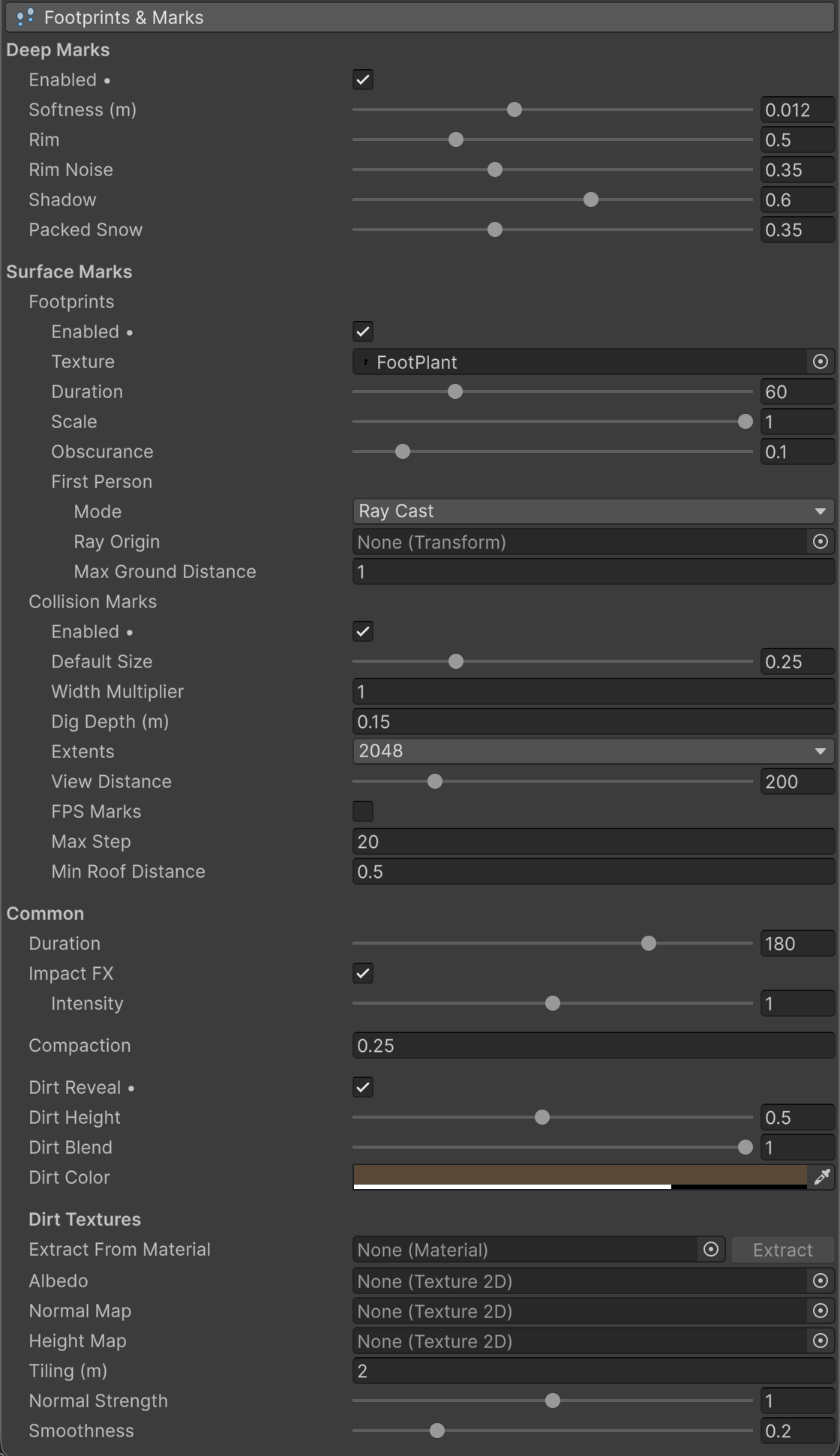
Deep Marks
Deep Marks work in Play mode and need a Thickness above 0 in Snow Appearance. Objects with Global Snow Interaction (characters, physics objects and vehicles on wheel colliders) and sources added by script dig real marks into the snow layer, on any ground, roof or object they rest on.
| Parameter | Description |
|---|---|
| Enabled | Turns on Deep Marks. Footprints and Collision Marks keep marking the snow where there is no deep mark. Default off. |
| Softness (m) | Smallest detail the snow keeps. The edges of the marks crumble at the same scale. Range 0 to 0.03. Default 0.012. |
| Rim | Snow pushed up along the edges of the marks. Range 0 to 2. Default 0.5. |
| Rim Noise | Irregularity of the rim. Range 0 to 1. Default 0.35. |
| Shadow | Strength of the shadow cast by the walls of the marks. 0 turns it off and skips its cost. The quality presets set it: 0.3 for Best and Medium, 0 for Fastest. Range 0 to 1. Default 0.3. |
Surface Marks
Footprints and Collision Marks are drawn on the snow. If Coverage Update is set to Disabled, the inspector warns that they may not render correctly.
| Parameter | Description |
|---|---|
| Footprints > Enabled | Turns on footprints. Characters with the Global Snow Interaction component leave a footprint per foot. Default off. |
| Footprints > Texture | Sole texture stamped at each footprint. If empty, the bundled sole is used. |
| Footprints > Duration | Seconds before the footprints fade out completely. Range 1 to 240. Default 60. |
| Footprints > Scale | Footprint size: world meters covered by each footprint. Increase it to make the footprints larger. Range 0.04 to 1. Default 1. |
| Footprints > Obscurance | Makes the footprints darker. Range 0.05 to 0.5. Default 0.1. |
| First Person > Mode | Footprints left by the camera (or the Ray Origin) as it moves, one sole per step on alternate sides. None: only characters with Global Snow Interaction leave footprints. Character Controller: steps count while the Character Controller is grounded. Ray Cast: a ray down to the ground checks each step. Default Ray Cast. |
| First Person > Character Controller | Character Controller used to know if the player is grounded. If empty, Global Snow looks for one in the hierarchy of the camera. |
| First Person > Ray Origin | Ray Cast mode. Transform used for the movement and the ground ray. If empty, the camera is used. |
| First Person > Max Ground Distance | Ray Cast mode. Maximum distance from the ray origin to the ground. Default 1. |
| Collision Marks > Enabled | Marks drawn on the snow where objects with Global Snow Interaction touch it, and by MarkAt() and MarkTrail(). Nothing is needed on the ground. Default off. |
| Collision Marks > Default Size | Size of the marks made by automatic collisions. Call MarkAt() to set a custom size. Range 0 to 1. Default 0.25. |
| Collision Marks > Width Multiplier | Makes the collision marks wider. Plow Mode trails ignore it, since their width comes from the contact. Default 1. |
| Collision Marks > Dig Depth (m) | Visual depth a mark digs on plain terrain. Plow Mode objects also use it to get the width of their trail. Default 0.15. |
| Collision Marks > Extents | Size of the internal texture that holds the collision marks: 512, 1024, 2048, 4096 or 8192. Default 2048. |
| Collision Marks > View Distance | Maximum distance from the camera where collision marks render. Reduce it if marks repeat, or increase Extents. Range 0 to 1024. Default 200. |
| Collision Marks > FPS Marks | Adds marks automatically when the camera moves. Use it only with a first person camera. Default off. |
| Collision Marks > Max Step | Maximum distance an object can move between two frames and still leave a continuous trail. Default 20. |
| Collision Marks > Min Roof Distance | Minimum distance from the mark to a roof above it. Use it to control when collision marks appear under a roof. Default 0.5. |
Common
| Parameter | Description |
|---|---|
| Duration | Seconds that Deep Marks and Collision Marks take to fill back in. Footprints have their own Duration. Shown when Deep Marks or Collision Marks are on. Range 1 to 240. Default 180. |
| Impact FX | Snow burst particles when feet, colliders or EmitImpactFX() hit the snow. They show in Play mode, in view of the camera and within 30 m, where the point has snow and no standing water, when Snow is above 0.5, at full strength from Snow 1. Wet snow (Snow Wetness or rain) throws less powder and a few bigger chunks. Default on. |
| Impact FX > Intensity | Strength of the impact particles. Range 0 to 2. Default 1. |
| Compaction | Extra smoothness of the pressed snow inside the marks. Default 0.25. |
| Dirt Reveal | Marks that reach the ground show dirt. When off, they show pressed snow. Default on. |
| Dirt Reveal > Dirt Floor (m) | Marks whose floor keeps less snow than this height over the ground show the dirt. 0 shows it only in the marks that reach the ground; an object with Sink Depth 1 always reaches it. Range 0 to 0.3. Default 0.02. |
| Dirt Reveal > Dirt Blend | 0 gives a hard edge at the Dirt Floor. 1 fades the dirt in from the Dirt Floor down to the bare ground. Range 0 to 1. Default 1. |
| Dirt Reveal > Dirt Color | Ground color shown by the marks. Alpha controls the intensity. |
| Dirt Textures > Extract From Material | Pick a material that uses the URP Lit property names and click Extract to copy its albedo, normal and height maps, its smoothness and its normal strength into the slots below. |
| Dirt Textures > Albedo | Ground albedo, tiled in world space. If empty, the bundled gravel textures are used. |
| Dirt Textures > Normal Map | Normal map of the ground. |
| Dirt Textures > Height Map | Breaks up the edge between snow and dirt: the high parts of the ground (pebbles, roots) show first. |
| Dirt Textures > Tiling (m) | World size of one texture repeat. Default 2. |
| Dirt Textures > Normal Strength | Strength of the ground normal map. Range 0 to 2. Default 1. |
| Dirt Textures > Smoothness | Smoothness of the ground. Range 0 to 1. Default 0.2. |
Snowfall, Dust & Wind
Procedural snowfall around the camera, snow dust near the ground and the wind they share with the rain. The amount of snowfall and snow dust is set with the sliders in the Weather block. Flakes do not fall under roofs seen by the top-down capture. Snow Dust needs the Depth Texture option in the URP asset, and the inspector shows an error when it is off.
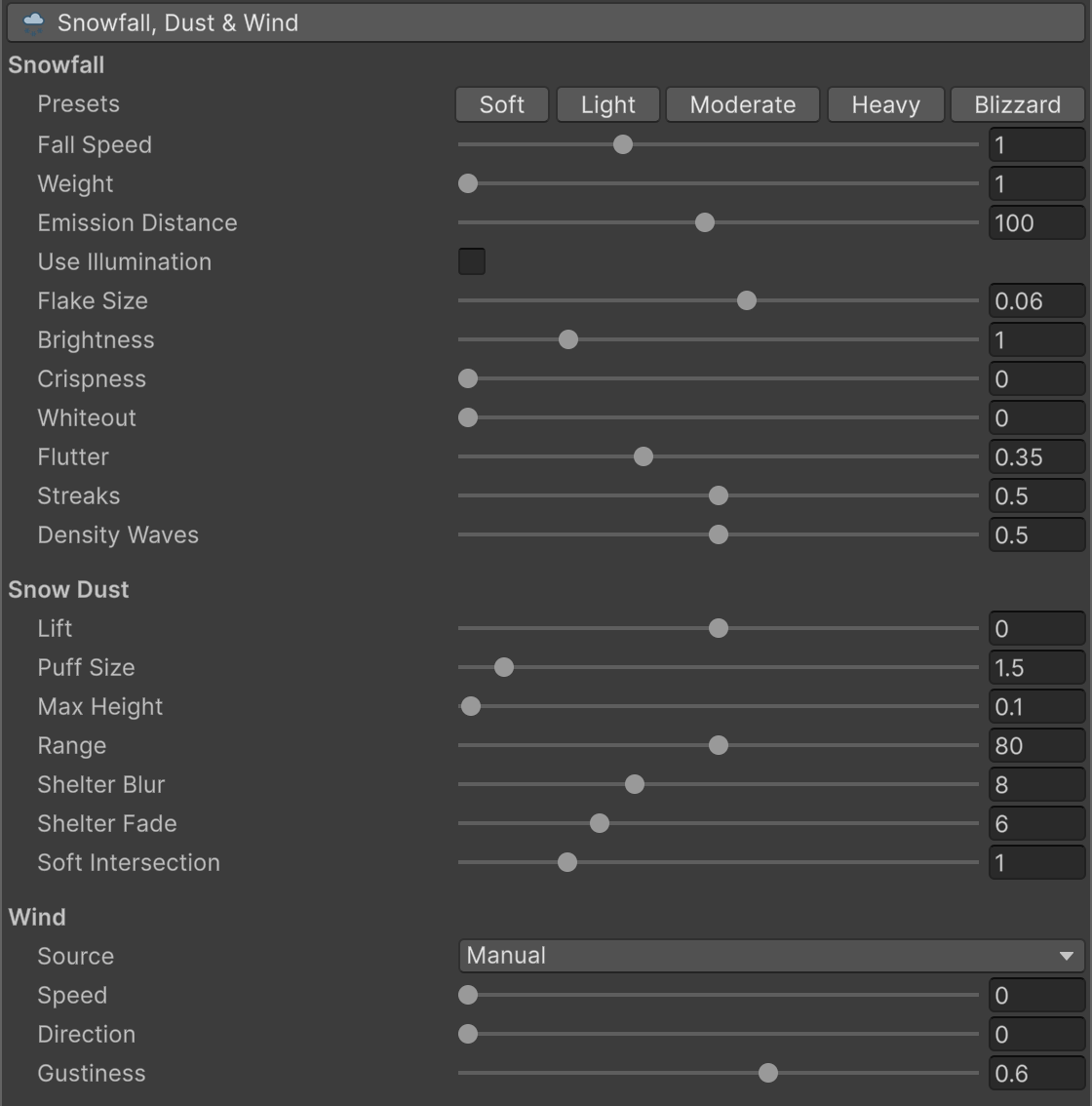
| Parameter | Description |
|---|---|
| Snowfall > Presets | One click weather looks, from calm flurries to a whiteout blizzard: Soft, Light, Moderate, Heavy and Blizzard. Each one sets the snowfall amount and look, the snow dust and the wind speed. |
| Snowfall > Fall Speed | Fall speed in meters per second (0.5 for light flakes, 1 to 2 for heavy snow). Small flakes fall slower and follow the wind more than large ones. Range 0.1 to 3. Default 1. |
| Snowfall > Weight | Resistance to wind and flutter. 1 keeps the normal motion, 2 halves the sideways response. It does not change Fall Speed, the wind or the snow dust. Range 1 to 10. Default 1. |
| Snowfall > Emission Distance | Size of the flake volume around the camera. Reduce it to concentrate the snowfall. Range 10 to 200. Default 100. |
| Snowfall > Use Illumination | Flakes catch light coming from the sun direction. Default off. |
| Snowfall > Flake Size | Base flake size in meters. Range 0.01 to 0.1. Default 0.06. |
| Snowfall > Brightness | Flake color multiplier. Above 1 pushes the flakes past white for bloom. Range 0.5 to 3. Default 1. |
| Snowfall > Crispness | 0 keeps the soft default look. Higher values make the flakes smaller and more solid. Range 0 to 1. Default 0. |
| Snowfall > Whiteout | Distance haze that fades the scene to white, for blizzards. Range 0 to 1. Default 0. |
| Snowfall > Flutter | Sideways drift as the flakes fall. Above 0.5 it adds a chaotic swirl for blizzards. Range 0 to 1. Default 0.35. |
| Snowfall > Streaks | How much a flake stretches along its motion, like in a camera exposure. Visible mostly with wind. Range 0 to 1. Default 0.5. |
| Snowfall > Density Waves | Bands of thicker and thinner snowfall that travel with the wind. Range 0 to 1. Default 0.5. |
| Snow Dust > Lift | Vertical offset of the puff centers from the ground, in meters. Negative values lower the volume. Range -5 to 5. Default 0. |
| Snow Dust > Puff Size | World size of the puffs in meters. Range 0.05 to 20. Default 1.5. |
| Snow Dust > Max Height | Maximum height of the puff centers above the ground, before adding Lift. Range 0.02 to 15. Default 0.1. |
| Snow Dust > Range | Width of the dust volume around the camera in meters, with a soft border. Range 40 to 120. Default 80. |
| Snow Dust > Shelter Blur | Radius in meters used to soften the shelter detection around roofs and obstacles. Range 2 to 20. Default 8. |
| Snow Dust > Shelter Fade | Transition distance in meters at the shelter borders. Larger values also slow down visibility changes. Range 1 to 20. Default 6. |
| Snow Dust > Soft Intersection | Distance in meters over which the puffs fade near solid geometry. Range 0.01 to 5. Default 1. |
| Wind > Source | Manual uses the Speed and Direction below. Wind Zone reads a WindZone in the scene, so trees, snowfall, snow dust and rain share one wind. Default Manual. |
| Wind > Wind Zone | Wind Zone source. A directional WindZone sets the direction with its forward axis and the speed with its Main strength. A spherical zone only sets the speed. If empty, the manual speed and direction are used. |
| Wind > Speed Scale | Wind Zone source. Meters per second of wind per unit of WindZone Main strength. The inspector also shows the current wind. Range 0.1 to 20. Default 5. |
| Wind > Speed | Manual source. Horizontal wind speed in meters per second, shared by snowfall, snow dust and rain. Range 0 to 20. Default 0. |
| Wind > Direction | Manual source. Direction the wind blows toward, in degrees: 0 = +X, 90 = +Z, 180 = -X, 270 = -Z. Default 0. |
| Wind > Gustiness | Strength of the wind gusts on snowfall and snow dust. Range 0 to 1. Default 0.6. |
Frost
Frost covers the ground and the lower part of walls with hoarfrost ice. Camera Frost adds frost to the camera view. Their amounts are the Frost and Camera Frost sliders in the Weather block.
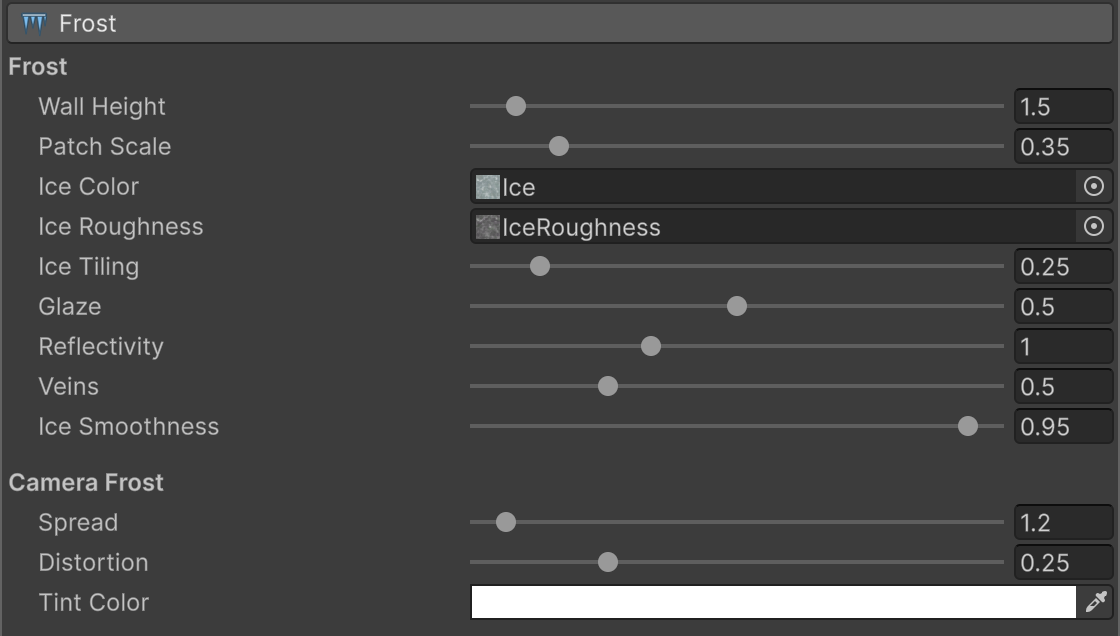
| Parameter | Description |
|---|---|
| Frost > Wall Height | How high the frost climbs walls, in meters, counted from the ground in front of each face. Faces sheltered from the sky stay free of frost. At the maximum, everything freezes, roofs and ceilings included. Range 0.1 to 20. Default 1.5. |
| Frost > Patch Scale | Scale of the frost patches when Frost is below 1. Higher values give smaller patches. The size of the ice detail is set by Ice Tiling. Range 0.05 to 2. Default 0.35. |
| Frost > Ice Color | Ice detail texture. Its bright areas become plate rims, cracks and frost specks. If empty, the bundled texture is used. |
| Frost > Ice Roughness | Roughness map of the ice detail. If empty, the bundled texture is used. |
| Frost > Ice Tiling | Ice detail repeats per meter. Range 0.02 to 2. Default 0.25. |
| Frost > Glaze | How much the ice darkens the surface below, like a wet glaze. Range 0 to 1. Default 0.5. |
| Frost > Reflectivity | Strength of the ice reflections: 0.5 for matte frost, 1 for real ice, 2 for a mirror pond. Range 0.5 to 2. Default 1. |
| Frost > Veins | Whiteness of the plate rims, cracks and frost specks. Range 0 to 2. Default 0.5. |
| Frost > Ice Smoothness | Glossiness of the ice plates. Range 0 to 1. Default 0.95. |
| Camera Frost > Spread | Shape of the frost edge: low values let the frost reach the center of the screen sooner, high values keep it along the borders until the intensity is high. Range 1 to 5. Default 1.2. |
| Camera Frost > Distortion | How much the frost refracts the view behind it. Range 0 to 1. Default 0.25. |
| Camera Frost > Tint Color | Tint color of the camera frost. Default white. |
Rain & Wetness
Falling rain, wet surfaces, running drops and puddles. The amount of rain and of standing water is set with the Rain and Puddles sliders in the Weather block. Some options show only when Rain or Puddles is above 0. See Rain & Water for how they work together.
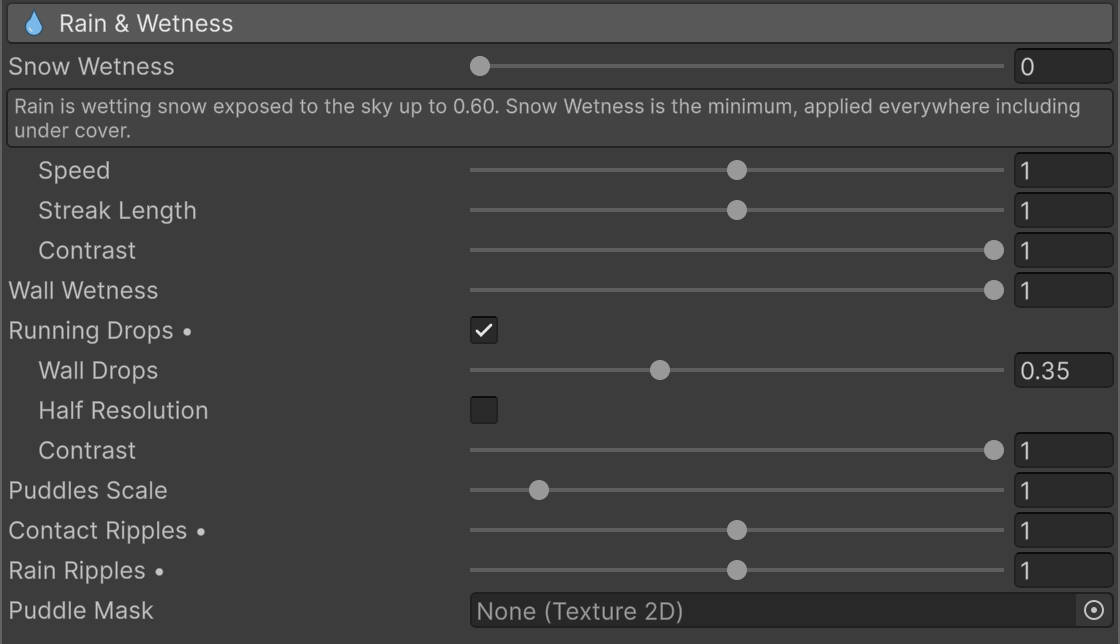
| Parameter | Description |
|---|---|
| Rain > Speed | Fall speed multiplier of the rain. Shown when Rain is above 0. Range 0.5 to 1.5. Default 1. |
| Rain > Streak Length | Length multiplier of the rain streaks. Range 0.5 to 1.5. Default 1. |
| Rain > Contrast | How visible the falling drops are, without changing the amount of rain. 1 keeps the streaks visible on bright sky or snow. At 0 the drops only bend the view behind them, like small lenses. Range 0 to 1. Default 1. |
| Snow Wetness | Wet or melting snow look: darker, smoother, softer normals and no sparkle. Rain also wets the snow exposed to the sky on its own. This value is the minimum, applied everywhere, also under cover. Range 0 to 1. Default 0. |
| Wall Wetness | How wet walls and other steep surfaces are on their own, rain or not. Rain adds to it, and wind also wets the walls that face it under small roofs, up to 1.5 m in. Range 0 to 1. Default 0. |
| Running Drops | Beads that appear on wet surfaces, run down under gravity, merge and leave trails. They show near the camera only, and they are the heaviest part of the rain. Default on. |
| Running Drops > Wall Drops | How many running drops appear on walls and other steep surfaces, compared with flat ground. Higher values give more drops on walls. Range 0 to 1. Default 0.35. |
| Running Drops > Half Resolution | Draws the running drops at half resolution. About half the cost, with softer drops. Default off. |
| Running Drops > Contrast | How much the running drops stand out. At 1 they also darken bright surfaces such as snow. At 0 they only show reflections and sun glints. Range 0 to 1. Default 1. |
| Puddles Scale | Scale of the procedural puddle pattern. Higher values give smaller, more isolated puddles. A Puddle Mask uses its own Mask World Size instead. Shown when Puddles is above 0. Range 0.1 to 8. Default 1. |
| Contact Ripples | Strength of the ripples that footprints, marks and impacts leave on the puddles. 0 turns them off. Range 0 to 2. Default 1. |
| Rain Ripples | Strength of the rings that rain drops leave on the puddles. 0 turns them off. Range 0 to 2. Default 1. |
| Puddle Mask | Optional texture mapped on the world that chooses where puddles can form (red channel). White areas get puddles first, black areas never get puddles. Without a mask, procedural patches are used. |
| Puddle Mask > Mask World Size | World meters covered by the puddle mask. The area outside the mask stays dry. Default 512. |
| Puddle Mask > Mask World Center | World X and Z position of the center of the puddle mask. Default 0, 0. |
| Camera Rain | Drops on the camera lens while it rains, scaled by Rain, so it needs Rain above 0. More drops land when the camera faces the rain or moves into it, and few with its back to the rain or looking down. The drops grow in the rain and, once they are heavy enough, run down with the slant of the rain without stopping until they leave the lens, joining other drops and leaving wet trails that dry. When the camera turns, the drops and trails already on the lens stay where they are. Under a roof no new drops land and the ones on the lens dry out. Only on the camera with Global Snow, never in the Scene View. Also in the Weather block. Range 0 to 1. Default 0. |
| Camera Rain > Drop Size | Size of the drops on the lens. Smaller drops bend the view the same way, only over a smaller area. Range 0.5 to 2. Default 1. |
| Camera Rain > Distortion | How much the drops bend the view behind them. Range 0 to 1. Default 0.5. |
Tools & Debug
Scene View preview, a split view to compare the scene with and without Global Snow, and debug views.
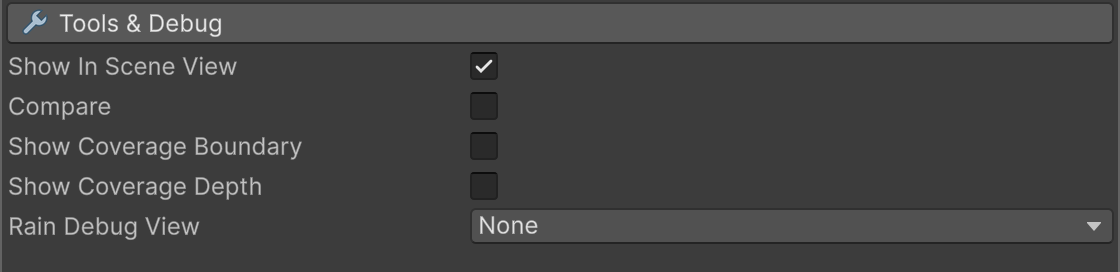
| Parameter | Description |
|---|---|
| Show In Scene View | Renders the snow in the Scene View. Default on. |
| Compare | Split view: one side of a line shows the scene without Global Snow. Default off. |
| Compare > Same Side | Both sides show the same view: a copy of the game camera renders the scene without Global Snow. Game camera only, the Scene View keeps the split. Default off. |
| Compare > Panning | Shown with Same Side. Shifts the view along the split so you can center the area you compare. Range 0 to 0.5. Default 0.25. |
| Compare > Line Angle | Angle of the split line in degrees, from -180 to 180. Default 80. |
| Compare > Line Width | Thickness of the split line as a fraction of the screen. Range 0.0001 to 0.05. Default 0.002. |
| Show Coverage Boundary | Shows a rectangle in the Scene View around the coverage area. Shown when Use Zenithal Coverage is on. Default off. |
| Show Coverage Depth | Shows the top-down coverage depth texture in the inspector. Not shown when Coverage Update is Disabled. Default off. |
| Update Coverage Now | Button shown in Play mode. Captures the coverage again. |
| Rain Debug View | None. Impact Rings shows the rain impact field as brightness. Running Drops Receiver shows where running drops can appear: black where they cannot appear, gray where they can. Default None. |
Next Steps
- Rain & Water - how rain, wetness, puddles, ripples and running drops work together.
- Additional Topics - footprints, deep marks, exclusions, coverage mask and profiles.
- Scripting Support (C#) - runtime API reference.
Suggest an improvement
Help us improve this documentation page.