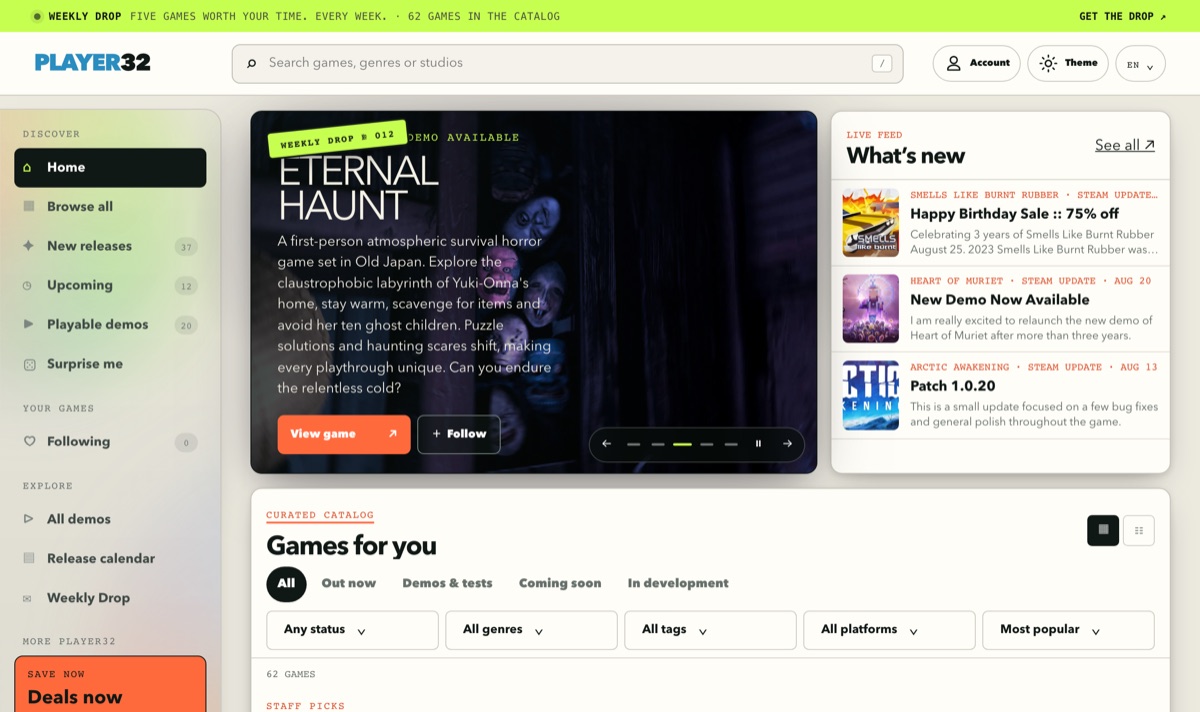
Today, at 18:00 CEST, Player32 opens to everyone. It is a small site with a simple promise: a hand-picked catalog of games where every title gets a proper page, with its screenshots, its original trailer, its availability and direct links to the official stores, in English, Spanish and Chinese. No commission, no paid placement, and every click goes to the studio's own store.
Why a tools company builds a games site
Kronnect has spent more than a decade making tools for Unity developers. Along the way we have watched hundreds of games get finished, polished with our assets, and then released into a market where being good is not enough to be found. The stores show what sells; social feeds show what is loud. A well-made game from a two-person studio can spend its launch week invisible.
We cannot change how the big stores rank things. We can build a place that treats every game as worth a page of its own, and that is Player32. It is our way of giving something back to the developers we have been working with since 2015.
What a page on Player32 is
A game page is written and kept up to date from the studio's official sources. It carries the trailer in its original quality, the screenshots, the release status, the platforms and the store links. It also gives the studio things it usually has to build for itself:
- Followers. Players can follow a game and receive its development updates and deals, only if they ask for them.
- Development updates. Studios post from their own panel; the best updates make it into the Weekly Drop, our weekly email to players.
- A press kit. Fact sheet, copy-ready text and downloadable art, in one link the studio can send to anyone.
- Three languages. The whole page is available in English, Spanish and Chinese, so a game can be found outside its home market.
The page is free, and it belongs to the studio: claim it and every word is yours to edit.
Missions: playtests that end in a report
The part of Player32 we care most about is missions. A playtest usually means posting a key in a Discord and hoping someone writes back. A mission turns that into something you can run and read.
The studio writes the mission from its panel: how to get the build (a Steam playtest, a download link or a public demo), how many seats are open, up to five tasks to try and up to five questions to answer. The mission goes live on the game's page and on the missions board with a countdown. Players and other developers join, play, and send one report each: minutes played, platform, the first thing they would change, and the studio's own questions. The author reads the reports in one place, the participants earn XP, and nobody has to chase anyone.
The XP is there to encourage exactly that kind of collaboration. Every report you write for someone else's game adds to your account, and those points will become redeemable: perks on Player32 and more visibility for your own games as a developer who shows up for others.
Missions are free, and they are not only for playtests. A localization check, a controller pass, a first look at a new level before it goes on the store page: anything a studio wants a dozen fresh eyes on fits the format. Making a game in a small team is lonely work, and this is a small way to make it less so.
Built for every stage of a game's life
A store page starts to matter on launch day. A Player32 page is meant to be useful from the first devlog to the long tail:
- In development. The page is up before there is anything to buy, with a wishlist link, followers who asked to hear from you, and missions to test what you are building with people who play.
- Launch. The page switches to out now, the Weekly Drop can feature the game to players who signed up for exactly that, and the press kit is ready for anyone who asks.
- After launch. Development updates keep the page alive, deals reach the followers, and the three languages keep the game visible in markets it never targeted.
How we build it
Player32 opens with a catalog we chose by hand, and it will grow the same way: editorially, one game at a time, with no way to buy a better position.
The site itself will not stand still. We ship changes every week, and the plan is to keep adding features that help developers at each of those stages: more ways to run a mission, better tools to reach the people who follow a game, and whatever studios tell us they need next. If you make games and something on Player32 would save you time or bring you players, write to us. The best features in our Unity tools came from a developer asking for them, and we intend to run Player32 the same way.
If you are making a game, you can add it from your account and we will build the page. If you play games, go and have a look. We hope you find something you would not have found otherwise.
Player32 is made by Kronnect. Questions and ideas: editor@player32.com.